The 11pm Call: Sump Pump Failure During a Power Outage
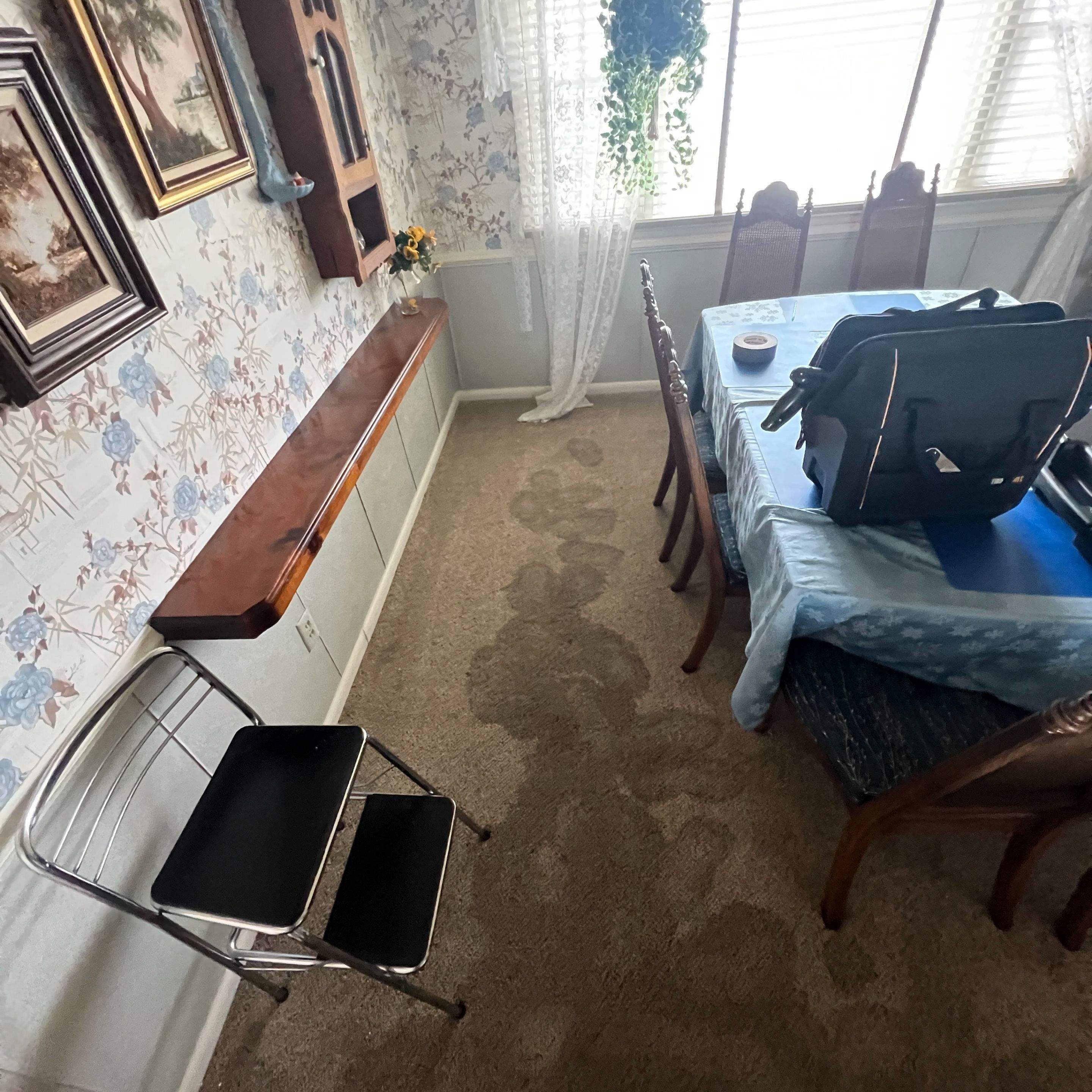
One Hunting Creek homeowner called us just before midnight during a July derecho. Her power had been out for three hours, the sump pit was overflowing, and water was creeping across the basement carpet toward a finished media room. By the time our crew arrived at 12:40am, roughly 800 square feet of carpet was saturated and water had reached about an inch and a half against the drywall.
We pulled two truck-mounted extractors inside and started pumping while a tech disengaged the wet baseboards. The water was Category 2 (gray water from groundwater intrusion mixed with whatever the sump basin had collected), so the pad came out, the bottom 16 inches of drywall got flood cuts, and we set 14 air movers and three commercial dehumidifiers. Total dry-out took 78 hours. Her insurance covered the loss because she had a sump pump and sewer backup rider, which costs about $50 to $100 a year and is the single best add-on for any Hunting Creek homeowner with a basement. Out-of-pocket was her $1,000 deductible against a $7,400 claim. If you want the full playbook on this scenario, our team wrote a detailed guide on sump pump failure and basement flooding solutions that mirrors exactly what we did at her house.
The detail most homeowners miss on this kind of loss is the battery backup question. Her primary pump worked fine. It just had no power. A $300 battery backup pump would have run for roughly seven hours on its own, which would have carried her through the outage with zero damage. We now bring that up on every estimate we write in a flood-prone Hunting Creek neighborhood, because the math is brutal: a $300 part versus a $7,400 claim and three months of repairs.
The Tree Through the Roof: When Storm Water Becomes Category 3
A different call came in on a Saturday morning after an overnight wind event. A large silver maple had split and dropped a limb through the roof of a Hunting Creek ranch, opening a hole roughly four feet across over the master bedroom. Rain poured into the attic for six hours before the homeowner noticed the ceiling sagging.
By the time we tarped the roof and got inside, the insulation was soaked, the bedroom ceiling had partially collapsed, and water had traveled down interior walls into the kitchen below. Because the water passed through attic insulation, fiberglass debris, and an unsealed roof cavity with bird and rodent contamination, we documented it as Category 3. That changes everything. Category 3 work requires containment barriers, PPE, antimicrobial treatment, and removal of porous materials that contacted the water. The homeowner initially pushed back on tearing out the kitchen ceiling drywall since it looked only lightly stained, but our moisture meter read 38% in the gypsum. It had to come down. Our storm damage restoration team coordinated directly with his adjuster, and the full scope, including reconstruction, ran $24,800. Insurance covered all of it minus a $2,500 wind/hail deductible.
What To Do in the 20 Minutes Before We Arrive
Every Hunting Creek homeowner asks the same question on the phone: what should I be doing right now? Our answer is short. If the water is clean and you can do it safely, move furniture legs onto foil or wood blocks, lift draperies off the floor, and pull up small area rugs. Take wide photos of every affected room before anything moves, then take close-ups of waterlines on walls and baseboards. Do not run a household vacuum on standing water, and do not plug in fans from outlets in the wet zone. One Hunting Creek Water Restoration customer last spring saved roughly $2,200 in hardwood refinishing by getting her dining chairs and a buffet off the floor in the eight minutes between her call and our arrival. Small actions, real dollars.
The Slow Build: Wind-Driven Rain Behind Siding
Not every storm job is dramatic. A Hunting Creek couple called us two weeks after a bad thunderstorm because they smelled something musty in their dining room. We pulled a section of siding on the windward wall and found that wind-driven rain had been pushed behind a failing piece of J-channel for years. Every storm added more moisture. The OSB sheathing was soft, the wall cavity insulation was matted, and black mold had colonized about 22 square feet of the back of the drywall.
That job is the one homeowners hate most because there is no insurance claim. Carriers classify it as long-term seepage and deny it. The fix was real work: siding removal, sheathing replacement, mold remediation under containment, new insulation, drywall, and paint. Final price came to $6,150. The lesson for Hunting Creek homeowners is simple. After any severe storm, walk your exterior. Look at caulking around windows, check siding seams on the side the wind hit, and feel interior walls for cool damp spots.
What Actually Happens in the First Hour
When our truck pulls up to a storm-flooded Hunting Creek home, the sequence is consistent:
- Safety check: power shutoff at the panel if water is near outlets, gas check if anything smells off, structural look at ceilings overhead
- Category determination using IICRC S500 standards (Cat 1 clean, Cat 2 gray, Cat 3 black)
- Moisture mapping with meters and thermal imaging so we know the actual wet footprint, not just what is visible
- Extraction first, demolition second, drying third, and only then any reconstruction conversation
- Photo documentation and a written scope your insurance adjuster can work from
Most Hunting Creek storm losses we see fall between $3,500 and $18,000 for the mitigation phase alone, with reconstruction on top of that if drywall, flooring, or cabinetry has to be replaced. If you want a deeper breakdown of how those numbers get built, our complete price breakdown guide walks through every line item adjusters look at.
The Insurance Conversation Homeowners Get Wrong
A Hunting Creek homeowner once told us, before we arrived, that he had already ripped out his own carpet and thrown the pad in the driveway. He thought he was helping. His adjuster later questioned the entire claim because there was no documentation of the original water depth, no moisture readings, and no proof the pad was actually saturated rather than just dirty. He got paid eventually, but the claim took six weeks longer than it should have.
Call your restoration company before you call your insurance company, or at least before you start tearing anything out. We document the loss in a way carriers accept, we use Xactimate pricing they recognize, and we deal with the adjuster directly so you can focus on your family.